Sublimation vs DTF
One of these works on any fabric in any color. The other feels like nothing at all when you wear it. That is the entire trade.
Heads up: Mat & Blade earns a commission from qualifying purchases made through the links on this page, at no extra cost to you. It never changes which products we recommend or how we rank them. Read the full disclosure.
DTF works on cotton and on dark fabric; sublimation does not. Sublimation leaves no feel on the garment; DTF does. Sublimation puts dye into polyester, so it only works on polyester or polymer-coated surfaces in white or light colors — and the result is permanently part of the fabric with nothing to touch. DTF prints onto a film that is bonded to the garment surface with adhesive powder, so it works on any fabric in any color but sits on top as a thin layer. For a beginner whose projects include cotton or dark shirts, DTF is the answer.
| Sublimation | DTF (direct to film) | |
|---|---|---|
| Works on cotton | No — needs polyester or a polymer coating | Yes |
| Works on dark fabric | No — the ink is translucent | Yes, including black |
| Feel on the garment | None — the dye is in the fiber | A thin flexible layer on the surface |
| Full color and gradients | Yes | Yes |
| Works on mugs, tumblers, hard blanks | Yes, on coated blanks | No — fabric and some fabric-like surfaces |
| Print your own at home | Yes, with a converted or dedicated printer | Possible, but the powder and curing step is messy |
| Buy transfers ready-made | Rarely — defeats the point | Yes, and this is how most beginners start |
| Press needed | Yes, flat or curved for the blank | Yes, flat |
| Durability | Excellent — does not crack or peel | Very good — better than HTV, can eventually crack |
| Entry cost at home | Printer, ink, paper, press, polyester blanks | Ready-made transfers plus a press — far less |
The one-paragraph version
Sublimation is the better process where it is allowed to work. The design becomes part of the fabric, so there is nothing to peel, nothing to crack, and nothing to feel — which on a performance shirt or a tumbler is genuinely superior to any surface-applied method. The catch is that "where it is allowed to work" is narrow: polyester, light colors, or a polymer-coated hard blank. DTF has no such limits and the penalty is that you can feel it.
Choose sublimation if
- Your blanks are polyester or coated. Performance tees, jerseys, tote faces, mousepads, mugs, tumblers, coasters, keyrings.
- You want to decorate hard goods. Mugs and tumblers are the single strongest argument for sublimation, and DTF cannot do them.
- Feel matters. Sportswear and anything worn next to skin. There is nothing on the surface at all.
- You want an all-over print. Sublimation can cover a whole garment panel without a stiff patch.
- You are happy working in white and light colors. This is not a limitation you can work around.
Choose DTF if
- You sell cotton tees or dark shirts. The majority of the apparel market, and sublimation cannot touch it.
- You want to start cheaply. Ready-made DTF transfers plus a press is the lowest-cost route to full-color apparel.
- You want one process for all blanks. No fabric-type sorting, no color restriction.
- You do not want to own or convert a printer. Ordering transfers is a real, widely used workflow, not a compromise.
- Your designs are detailed or photographic on dark fabric. This is where DTF has no competition from any cut-vinyl method.
1. Best for the cheapest way to test the sublimation route
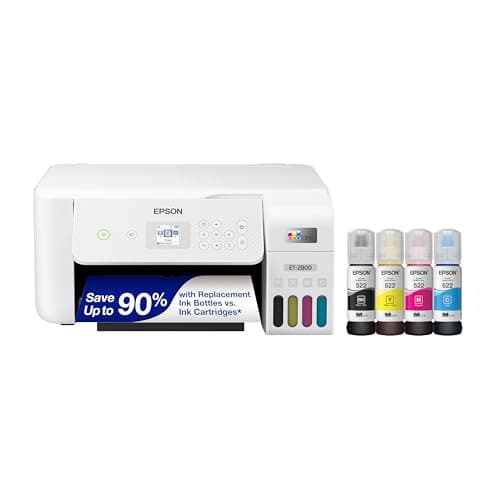
Epson EcoTank ET-2800
Epson · Currently sold · Verified 2026-09-27
If sublimation is the direction, this is where most people start. It is a refillable-tank inkjet sold as an ordinary printer, which people convert by filling the tanks with sublimation ink, and it prints up to 8.5 in wide. Be clear-eyed about what you are agreeing to: it is not sold as a sublimation printer, the conversion is one-way, and Epson's warranty covers damage from genuine ink rather than third-party ink. For testing whether sublimation suits your projects at all, it is the low-risk entry point.
What works
- By far the cheapest way to start sublimating
- Refillable tanks mean low running cost once converted
- Very widely documented by the crafting community
What does not
- Converting it with third-party sublimation ink voids Epson's coverage for ink-related damage
- A converted printer cannot go back to regular ink
- 8.5 in width limits you to letter-size transfers
Not for you if
You want a supported, warrantied sublimation setup you can call for help on. Buy a dedicated sublimation printer instead.
Key specs
- Type
- Refillable-tank inkjet — sold as a regular printer
- Sublimation
- Not a sublimation printer as sold; people convert it
- Max print width
- 8.5 in (letter)
- Ink system
- Four refillable tanks
- Warranty note
- Epson's warranty covers damage from genuine ink, not third-party ink
#ad · affiliate link · we never show a price we cannot verify
2. Best for sublimation with a warranty behind it
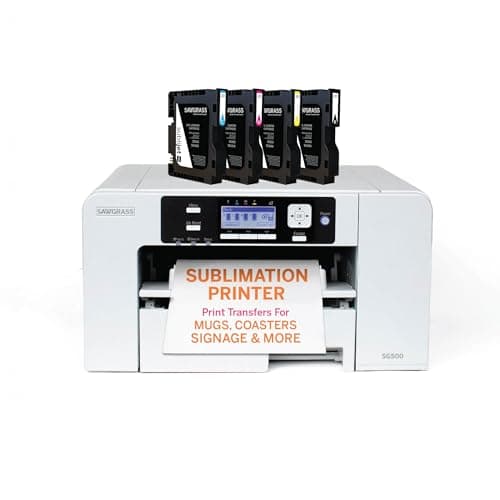
Sawgrass SG500
Sawgrass · Currently sold · Verified 2026-09-27
The alternative to converting a printer is buying one sold for the job. The SG500 is a dedicated sublimation printer using Sawgrass SubliJet cartridges, prints up to 8.5 in wide, and comes with manufacturer support and warranty for sublimation use — which is precisely what a converted EcoTank gives up. It costs more up front and more per cartridge. If sublimation is going to be a business rather than an experiment, that support is worth paying for.
What works
- No conversion, no warranty question, no community workaround
- Color profiles supplied and supported by the manufacturer
- Manufacturer support when something goes wrong
What does not
- Much higher purchase price than a converted EcoTank
- Cartridge ink costs considerably more per page than tank ink
- Same 8.5 in width limit as the cheap option
Not for you if
You are experimenting to see whether you like sublimation at all. That is a lot of money to spend on a maybe.
Key specs
- Type
- Dedicated sublimation printer
- Sold as
- A sublimation printer — no conversion involved
- Max print size
- 8.5 x 14 in from the main tray; up to 8.5 x 51 in via the bypass tray
- Resolution
- Published at up to 4880 x 1200 dpi
- Ink
- Sawgrass SubliJet UHD sublimation ink cartridges (non-refillable)
- Connectivity
- Ethernet, USB and 2.4GHz Wi-Fi
- Support
- 3-year or 100,000-print warranty with lifetime tech support
Price as of November 12, 2026
#ad · affiliate link · we never show a price we cannot verify
3. Best for the press both routes need — and dtf needs more of it
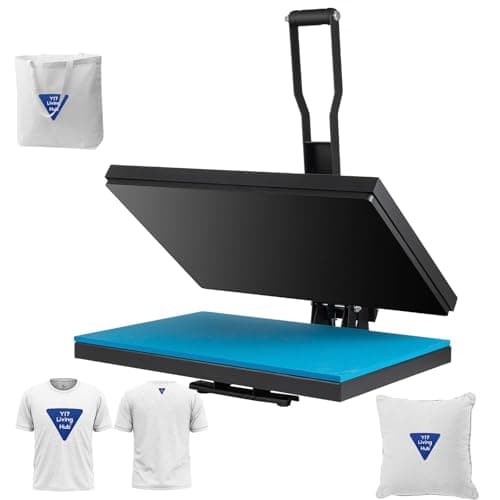
SmarketBuy 16 x 20 Clamshell Heat Press
SmarketBuy · Currently sold · Verified 2026-09-29
Whichever side you land on, a press is compulsory, and DTF asks more of it than sublimation does. DTF bonds through adhesive powder, so it wants firm, even, repeatable pressure across the whole design — which is what an adjustable clamp gives you and a handheld press does not. A 16 x 20 in high-pressure clamshell at 1700 W covers hoodies and oversized prints as well as tees, and runs the same timed cycle for sublimation transfers. It is permanent bench space, and more of it than a 15 x 15.
What works
- Presses a hoodie front or an oversized design in a single pass
- Covers a full 13 x 19 transfer, which a 15 x 15 platen cannot
- Clamp pressure repeats exactly, which matters most on thick garments
What does not
- Heavy, and it needs considerably more bench space than a 15 x 15
- Overkill for standard adult front prints, which fit a smaller platen
- Takes longer to reach temperature than a small plate
Not for you if
You press standard adult t-shirt designs a few times a month. A 15 by 15 platen already covers those, for less money and less table.
Key specs
- Type
- High-pressure clamshell heat press, 1700 W
- Platen size
- 16 x 20 in
- Pressure
- Adjustable clamp — repeatable every press
- Bench space
- Permanent, and more of it than a 15 x 15
- Typical use
- Hoodies, DTF transfers, oversized prints, batch work
Price as of November 12, 2026
#ad · affiliate link · we never show a price we cannot verify
4. Best for the fabric sublimation actually needs
Polyester Blank Shirts
Joyclub · Currently sold · Verified 2026-09-27
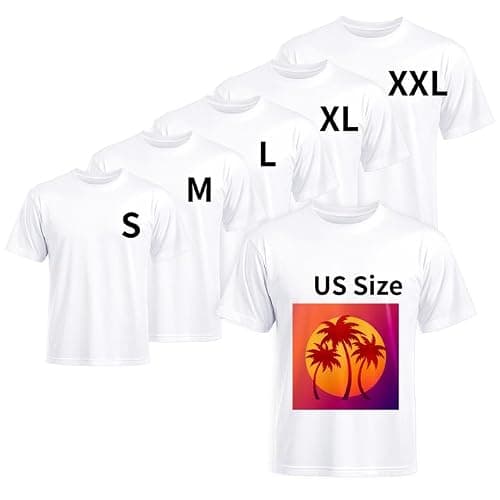
This is the constraint that decides the whole comparison. Sublimation ink bonds to polymer, not to cotton fiber, so you need 100% polyester or a high-polyester blend, and it has to be white or very light because the ink is translucent. A 65/35 blend gives a deliberately faded, vintage-looking result. If your product list includes dark shirts or cotton tees, this is the row where sublimation rules itself out and DTF does not.
What works
- The only fabric sublimation genuinely bonds to
- Result has no hand feel at all — the design is in the fabric
- Will not crack or peel the way a vinyl transfer can
What does not
- White or near-white only — this is a hard physical limit
- 100% polyester feels different from a cotton tee
- Blends fade the design, which you may or may not want
Not for you if
You want a soft cotton shirt or a dark shirt. Use heat transfer vinyl instead — it works on both.
Key specs
- Fabric
- 100% polyester, or a high-polyester blend
- Color
- White or very light — dark fabric will not work
- Why polyester
- Sublimation ink bonds to polymer, not to cotton fiber
- Blend behavior
- A 65/35 blend gives a faded, vintage-looking result
Price as of November 12, 2026
#ad · affiliate link · we never show a price we cannot verify
What each setup costs to start
The honest comparison is not printer against printer. Almost nobody starts DTF by buying a DTF printer — the powder application and curing stages are messy and awkward at home, so beginners order transfers from a supplier and press them. That makes the DTF entry cost a heat press and a stack of transfers, which is the cheapest route to full-color apparel available.
Sublimation at home means a printer (converted EcoTank or dedicated Sawgrass), sublimation ink, sublimation paper, a press, and polyester blanks — plus a curved press if tumblers are the goal. It is more to buy and more to learn, and in exchange you control the whole process and the per-item cost drops a lot. Sublimation startup costs breaks that down, and is sublimation worth it is the honest verdict on whether to bother.
Running both
This is what most small apparel shops do, and the split is clean: sublimation for polyester, performance wear, tumblers and mugs; DTF for cotton tees, hoodies and anything dark. Neither replaces the other, and the heat press is shared between them — which is a reason to buy a press with adjustable clamp pressure rather than a handheld if you expect to end up doing both. The best heat press for DTF transfers covers the press requirements, which are stricter for DTF than for HTV.
If you are also weighing cut vinyl, the three-way picture is worth having: sublimation versus HTV covers the feel and fabric trade, and sublimation HTV versus DTF covers the narrower comparison between printable sublimation vinyl and DTF film.
Common questions
Is sublimation or DTF better?
Can you sublimate on cotton?
Does DTF work on black shirts?
Which is cheaper to start, sublimation or DTF?
Which lasts longer?
Can you use DTF on mugs and tumblers?
Sources
- Google Autocomplete — 'sublimation vs' — 'sublimation vs dtf' returned as the first completion - checked 17 October 2026
- Epson EcoTank ET-2800 — manufacturer specification — Confirmed refillable-tank design, letter-width printing and the warranty position on non-genuine ink - checked 17 October 2026
- Sawgrass SG500 — manufacturer product page — Confirmed it is sold as a dedicated sublimation printer using SubliJet ink with manufacturer support for sublimation use - checked 17 October 2026
How we picked
We verify every product is currently sold by reading the manufacturer's own catalog, compare published specifications rather than marketing copy, and rank on what a first-time buyer has to decide. We do not run lab tests and we do not claim to, and commission never affects the order.
Read this next
Sublimation vs HTV
The category-defining comparison: what each technology can and cannot do, and which to start with.
Sublimation HTV vs DTF
The two methods that put full-color prints on cotton and dark garments, and which one suits a setup you already own.
Can You Sublimate on Dark Shirts?
Why sublimation needs a white or very light substrate, what sublimation paper for dark fabric actually is, and the methods that do print on black shirts.
Can You Sublimate on Cotton?
Why sublimation ink will not stay in cotton fiber, what the sprays and coatings really achieve, and the two methods that do work on a cotton shirt.
The Best Heat Press for DTF Transfers
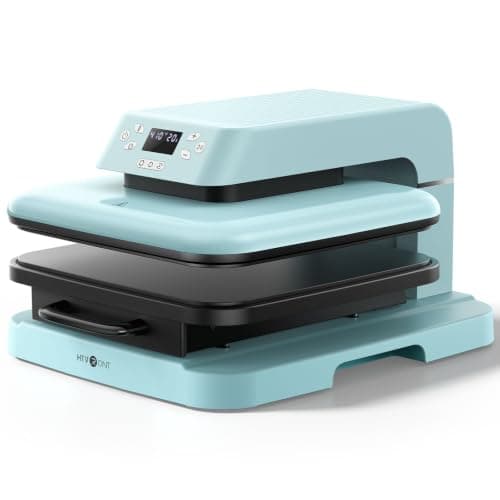
Which presses handle DTF transfers properly, and the pressure and peel details that decide the result.
Is Sublimation Worth It?
What sublimation is genuinely worth it for, what it cannot do at any price, and the full cost of getting started.
Back to Sublimation.